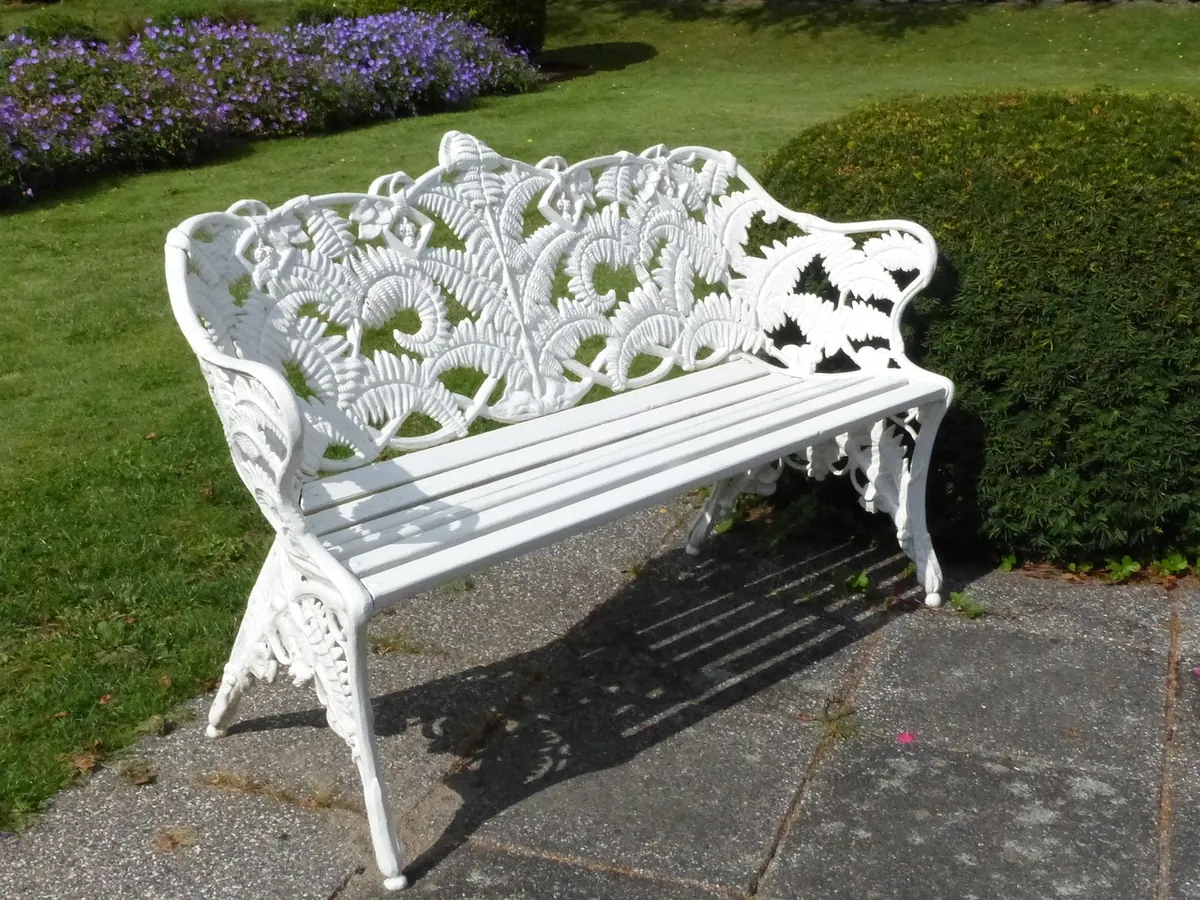
A garden bench is a promise: somewhere to sit with a mug of tea and watch the border fill out. It is also a piece of furniture that fails quietly. A bench that rocks, faces a fence or sits in the one corner that never gets sun doesn't announce its problem — it simply stops being used. Most disappointing benches in British gardens aren't badly made; they're badly sited. Every one of these mistakes is easy to catch before you commit, and almost all of them take less than ten minutes of standing, sitting and staring to spot. The trick is to test the place before the bench arrives, not two summers later, when the thing is mossy, wobbly and quietly holding a pot of dead bulbs.
The most common error is putting a bench straight onto soil or a tired patio. Grass looks level from standing height and rarely is. A dip under one leg makes the bench rock, rocking makes the joints flex every time someone sits down, and flexing is how a wooden bench loosens and a metal one starts to creak. Give it a season and the front legs will have sunk, the seat will slope forward, and every cup of tea will slide gently towards the edge.
Run a spirit level along the seat and across the front, then sit and shift your weight from side to side. If you feel any movement, fix the ground before the bench. On soil, lift the turf, firm a base of compacted hardcore or gravel and bed the legs onto slabs. On paving, tap the slab under each leg; if it sounds hollow, lift and re-bed it. On decking, set the feet across the joists rather than between them, so the boards are supported underneath.
A pair of small paving slabs set flush with the lawn, one under each end, is the cheapest insurance there is. It spreads the load, keeps the feet out of the wet and makes the bench easy to slide aside when you cut the grass. Set them so the finished surface sits just below the grass, and you'll barely see them.
A bench against a wall or fence feels sheltered, which is why so many end up there — but check what that surface does to the bench and to you. A wooden fence holds moisture, and a bench pressed flat against it keeps the back of the seat damp and speeds up rot. Leave a gap of a few centimetres so air can move behind. That gap matters most on a north-facing boundary, where the surface behind a bench can stay wet for days after rain, and the back of your jacket will find it long before you do.
Watch the drip line, too. A shed roof without a gutter empties a surprising volume of water onto one small patch, often exactly where you have placed a seat. The same goes for a downpipe, a hanging basket that gets watered daily, and the overhanging branch of a big tree, which will deposit leaves, sap and the occasional contribution from the local birdlife.
And think about the house: a bench directly under a ground-floor window blocks light, gives the room a waiting-room feel and puts your head at window height when you sit down. Slide it along the wall so it sits beside the window rather than beneath it. If you want the shelter of the wall without the gloom, angle the bench slightly away from it, or park a shrub at one end to break the flat line.
Every garden has a sightline that earns its keep — the view from the kitchen sink, the gap between two shrubs, the long diagonal across the lawn, the sunset over the fence. Benches are low, wide and very easy to plant straight across them.
Stand where you actually stand: back door, patio, washing line, kitchen window. Note what you look at, then check the bench isn't sitting in that line. The usual offenders:
If the best view and the best seating spot happen to be the same place, that's fine — angle the bench towards the view rather than sitting square across it.
Most benches are placed on a bright Saturday morning and judged on the spot. Come back at seven in the evening and the picture changes completely. A seat that bakes at noon can be in the shadow of the house by five, and a spot that looks wide open in April may be under a canopy of leaves by June.
Visit the intended position three times — mid-morning, mid-afternoon and early evening — and note where the shadow falls, which way the wind comes from, and whether the seat faces the setting sun or turns its back on it. Two things are worth checking in particular:
A low sun in January reaches places a high summer sun never touches, and vice versa. If you want a bench for the darker months — the five minutes outdoors with a cup of coffee on a cold, clear day — look for a spot that catches light when the sun is low, which usually means somewhere near a south-facing wall.
A bench on an exposed corner can be lovely on a still day and unusable on nine out of ten others. A hedge, a wall or even a large potted shrub to windward makes more difference to how often you sit down than any cushion or throw.
A shady bench is not a mistake, of course: a cool seat under a tree is exactly what you want in a heatwave. The mistake is placing a bench for shade and then expecting to use it for morning tea in May.
So-called two-seater benches often seat one adult comfortably and two only if they are very fond of each other. Measure before you buy. Allow roughly 60cm of seat width per person, and check the seat height, which should be around 45cm — the same as a dining chair. Much lower and standing up becomes a project; much higher and your feet dangle.
Check that the bench suits the space, not just the sitters. A wide bench at the end of a narrow path makes the path feel closed. A small bench against a long, tall wall looks lost and pointless. Arms are worth a thought, too: they make it harder to slide on and off, and they rule out lying down on a warm afternoon, which is half the point of a bench in the first place.
Finally, sit in the spot — on a kitchen chair will do — and look around from sitting height, not standing height. A few practical checks:
Site the bench first, buy the bench second. The best bench in the wrong place is worse than a folding chair in the right one.
None of this is complicated. Walk the garden, stand where you stand, sit where you plan to sit, and check the ground below, the surface behind, the view in front and the sun above. Do that once, properly, and the bench will earn its place instead of becoming another thing to move.
Photo: Tingeling / Pixabay

A practical guide to digging, edging and compacting a durable gravel path and seating pad around a garden bench,...

Practical ways to cut the workload in a small British garden, from gravel and raised beds to evergreen structure,...

Yellow leaves, soggy compost and straggly growth usually trace back to a handful of container-care mistakes. Here's...

Gardening wisdom for your outdoor space..
